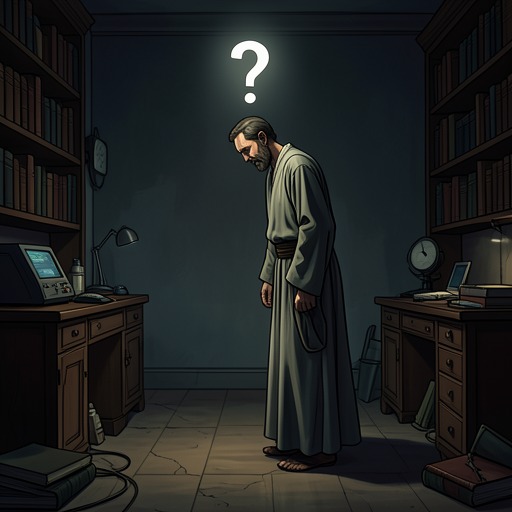
“What have you done with your life”
Life After Life“What have you done with your life?” is the defining question associated with the Life review in Raymond Moody’s account of near-death experiences. Reported as a nonverbal question from a loving Being of light, it turns the review from a mere display of remembered events into an assessment of how a life was lived: not by an outside judge announcing a sentence, but through the subject’s own heightened recognition of actions, motives, and consequences.
The Question Within the Life Review
The question arises in a recurring account of the Life review. People describe a panoramic, wraparound, full-color, three-dimensional vision in which events from their lives appear instantaneously. Some report seeing the major events; others say that every thing they had done or thought was present. The good and the bad are shown together, rather than arranged as a sequence of evidence presented by a human tribunal.
In these accounts, a Being of light is often present. Some Christian subjects identify the figure as Jesus Christ. The question is described as being asked in effect, and nonverbally: it accompanies the vision rather than interrupting it with an ordinary spoken exchange. Its open wording asks the subject to consider a whole life, while the simultaneous panorama supplies the material for that consideration.
Motive, Consequence, and Self-Judgment
When subjects are pressed to explain what the question means, many connect it to motive. One concise interpretation reported by Moody is whether a person did what they did because they loved others. The emphasis therefore falls not only on what happened, but on the quality of intention with which a person acted.
The review can bring sharply different responses to different memories. Subjects describe intense repentance when they see selfish acts and satisfaction when they see occasions of love and kindness. Some also report seeing the consequences of their actions for other people, widening the assessment beyond the actor’s own intentions. The question thus links conduct, motive, and impact: a life is examined in relation to the people affected by it, not simply counted as a list of deeds.
Moody stresses that the judgment in the cases he studied came from within the person undergoing the review, not from condemnation by the Being of light. That being appears loving and accepting even while the person sees shortcomings plainly. The question’s force lies in this contrast: acceptance is reported as continuing, while the subject’s own perception of selfishness or kindness becomes more acute. The review is not described as an external sentence imposed on the person, but as a recognition that can produce shame, repentance, or satisfaction.
A Different Idea of Judgment
The question has theological resonance because it can sound like a judgment, yet Moody distinguishes the reported Life review from a conventional reward-and-punishment ordeal in which an authority decides whether someone may enter the afterlife. In his account, the decisive appraisal is inward. A passage in The Bible about judgment provides a point of comparison, but Moody presents the experiences as reports that may be likened to theological ideas, not as a demonstration that settles them.
He also distinguishes the review from the Final Judgment. Because that event has not taken place, he argues, a report that it had occurred during a near-death experience would count against the report’s validity. The experiences, as he describes them, neither establish that there will be no Final Judgment nor claim to have disclosed one. The question concerns the subject’s life as it is encountered in the review; it does not amount to a declaration about the final fate of humanity.
Meaning and Limits
Moody places the question within a phenomenon whose descriptions, he cautions, rely on analogy for experiences that may exceed ordinary language. The Life review may resemble a judgment, but its reported form differs from a courtroom or an admissions test: the events are shown together, the subject’s own response supplies the evaluation, and the Being of light remains loving and accepting.
Moody likewise separates his personal religious conviction from a claim of proof. He says that he has come to accept life after death as a matter of religious faith and believes the phenomenon is a manifestation of it, while maintaining that this is his personal view rather than a logical conclusion he seeks to impose. In that framework, “What have you done with your life?” is consequential less as a doctrinal verdict than as a prompt to examine a life through love, responsibility, and the effects of one’s actions.